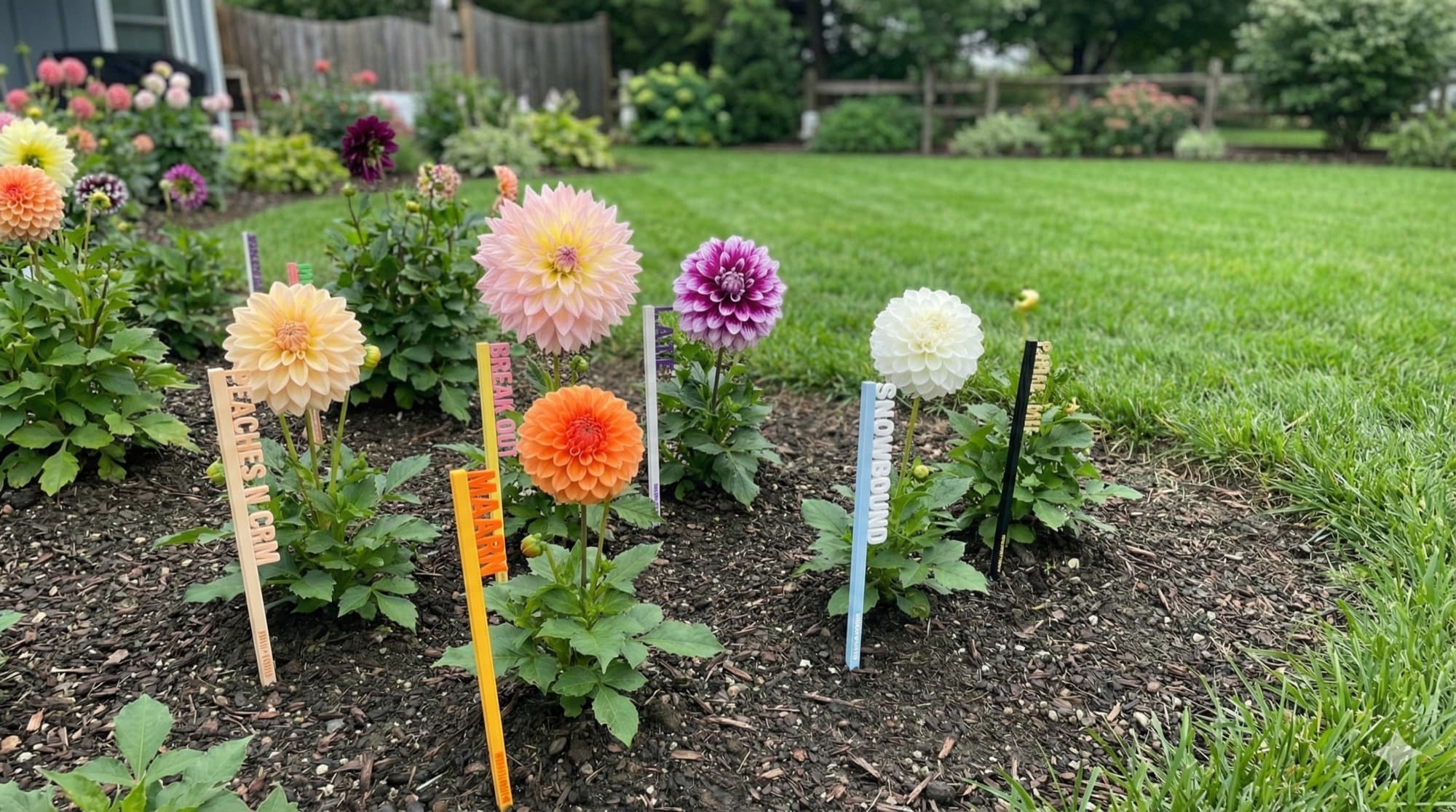
If you grow dahlias, you know the feeling. You dig up your tubers in the fall, toss them in bins, and by spring you're staring at a pile of brown clumps with no idea which one is Café au Lait and which one is Thomas Edison. Every dahlia grower we've talked to has lost a variety this way. Most have lost several.
The problem isn't carelessness — it's that most labeling methods just don't hold up. Here's what we've learned about what works and what doesn't from years of making labels for dahlia growers.
Why labeling dahlias is harder than other plants
Most garden plants stay in the ground. You put a marker next to your tomatoes in May and it's still there in September. Dahlias are different. You dig them up, divide them, store them for months, and replant them somewhere new. Your label has to survive the garden, the digging, the storage bin, and the replanting — often across two seasons.
That's where most methods fall apart.
The common methods (and why they fail)
Sharpie on plastic tags
This is what most people start with. Write the variety name on a plastic plant tag and stick it in the ground. It works for about six weeks. Then the UV light breaks down the ink and you're left with a blank white tag. By storage time, you can barely read it. By spring, it's gone completely.
Pencil on wooden stakes
Pencil actually holds up better than Sharpie in UV light — graphite doesn't fade the same way. But wooden stakes rot. One wet season and the wood softens, splits, or grows mold. And pencil is hard to read from more than a foot away.
Metal markers
Stamped aluminum or zinc markers last a long time, and they look nice. The downside is they're expensive, slow to make (you're stamping one letter at a time), and they conduct heat in summer which can stress nearby stems. They work, but they're not practical if you're labeling 30+ varieties.
Tape on tubers
Some growers wrap masking tape around the tuber stem and write the name on it. This works surprisingly well for storage, but the tape falls off, gets damp, or loses its adhesive over a few months. And it does nothing for you while the dahlias are in the ground.
What actually works
The best dahlia labeling method needs to do three things: survive UV light all summer, be readable from a few feet away in the garden, and travel with the tuber from bed to storage bin and back.
That's why a lot of growers have started using 3D-printed plant picks with raised lettering. The text is physically part of the plastic — it can't fade, wash off, or wear away. PETG plastic (the kind used in water bottles) holds up to UV light for years without getting brittle. And because the lettering is raised and color-contrasted, you can read the variety name from standing height.
They work in the garden bed during the season and then go right into the storage bin with the tubers in fall. Same label, both uses.
Tips for keeping track of your collection
Whatever labeling method you use, a few habits make a big difference:
- Label immediately when you plant. Don't tell yourself you'll remember — you won't.
- Keep a master list somewhere (a notebook, a spreadsheet, even your phone). If a label does get lost, you have a backup.
- When you dig and divide, label every division right away — not after you've got 40 tubers on the table.
- Use a consistent color system if you grow a lot of varieties. Some growers color-code by bloom type (dinnerplate, ball, pompon) so they can scan the garden at a glance.
- For long variety names, use abbreviations that still make sense at a glance. "Café au Lait" becomes "CAL," "Penhill Dark Monarch" becomes "PDM." If you need help coming up with short codes, we built a free Dahlia Decoder tool that generates abbreviations for any variety name — handy when you're labeling 50+ varieties and need to keep things readable.
One less thing to worry about
Growing dahlias is already enough work — digging, dividing, storing, watching for rot, battling slugs. Labeling shouldn't be the thing that trips you up. Find a method that holds up and stick with it. Your spring self will thank you.